


How to Water Pots While You Are Away: A Practical Guide
Posted by Amy Hall on 27th Nov 2026
How to Water Pots While You Are Away: A Practical Guide
The best way to water pots while you are away is to match the method to the length of your trip: a thorough soak and a shady spot for a long weekend, grouped pots with a reservoir for a week or so, and a self-watering planter or a trusted helper for anything longer. Pots dry out far faster than plants in the ground, so the work is mostly done before you leave. Our self-watering and traditional planters are there for the longer trips, and the rest of this guide takes you through each step calmly, in the order you would do them.
TL;DR
- Water every pot thoroughly a day or two before you leave, and move containers into shade and shelter.
- Group pots together so they shade each other and hold humidity.
- For a few days, saucers or capillary matting are enough. For longer, use a self-watering planter or ask someone to help.
- Whatever method you pick, test it for a few days before you go.
- Check that water is soaking in, not running straight out of the drainage holes.
Table of Contents
- 1. Know why pots dry out so quickly
- 2. Water thoroughly before you leave
- 3. Fix the pots that let water run straight through
- 4. Move and group your pots
- 5. Use saucers, capillary matting or a simple wick
- 6. Choose a self-watering planter for longer trips
- 7. Test your method before you go
- 8. Match the method to the length of your trip
- Why a good pot makes the difference
- Stock up before your next trip
- Our view: set it up once, enjoy the trip
- FAQ
- Sources
1. Know why pots dry out so quickly
A pot holds only a small amount of compost, and that compost is the plant’s entire water supply. The RHS points out that container plants and hanging baskets dry out faster than plants growing in the ground, because they simply hold far less moisture. Roots cannot reach down for more, and the sides of the pot warm in the sun.
That is why the answer to “should you water pots every day?” depends on the season. In a warm, sunny spell, small pots and baskets can need water daily. In cool, cloudy weather, a good soak may last several days. When you are going away, you cannot adjust from day to day, so you plan for the worst afternoon of your trip rather than the average one.
Two things make the biggest difference: how much water the pot can store, and how much sun and wind it gets. Larger pots hold more. Shaded, sheltered pots lose less. Most of the steps below work on one of those two things.
2. Water thoroughly before you leave
For a short summer absence, the RHS says that watering thoroughly before you go may be enough, especially if you also move plants somewhere cooler or away from a bright window. The word that matters is thoroughly. A quick splash wets the top few centimetres and leaves the root ball dry.
Here is a routine that works well:
- Water one or two days before you leave, not on the morning of departure, so you can see how the pots behave.
- Water slowly, in two or three rounds, pausing between each so the compost can absorb it.
- Keep going until water drips from the drainage holes.
- Lift a pot afterwards. It should feel noticeably heavier than before.
- Push a finger into the compost, about 2 to 3 cm down in a small pot. It should feel damp, not just the surface.
The finger test matters because a surface that looks dark and wet can hide dry compost below. If you would like a more reliable check, a water sensor gives you a reading from the root zone, so you are not relying on how the top layer looks.
3. Fix the pots that let water run straight through
If water gushes out of the bottom within seconds, the pot has probably dried so much that the compost has shrunk away from the sides. Water then runs down the gap and never soaks the roots. It is one of the most common reasons a plant wilts despite being watered.
The fix is patience rather than force:
- Water a little, wait ten minutes, then water again.
- Press the compost gently back against the pot wall with your fingers.
- For a badly dried pot, stand it in a bucket or washing-up bowl of water for half an hour, then let it drain fully.
Drainage matters here too. Holes that are blocked or too few leave roots sitting wet, while a pot with no way to hold water at all dries in a day. Our guide to planter drainage options explains what works and what does not, which is worth a read before you choose pots for the summer.
4. Move and group your pots
The RHS recommends moving containers into shade and shelter and grouping them together before you leave. This one step can stretch your watering by several days.
Why it works:
- Out of direct midday sun, compost loses water more slowly.
- Out of the wind, leaves lose less moisture.
- A tight group of pots shades each other’s sides and keeps the air around them more humid.
A north-facing wall, the shade of a fence or the space under a bench or table all work. Take hanging baskets down and stand them on the ground, because they dry out fastest of all. If you have a patio dining set, the shaded floor underneath is a handy parking spot.
For houseplants, the advice is similar. Move them away from bright south-facing windows, into a cooler room if you can, and keep them out of full sun, as a window can heat up a lot when the house is empty.
If you want to cut the amount of watering your garden needs in general, this overview of ways to cut garden watering covers several ideas, including mulching and smarter routines, that apply to pots as well as beds.
5. Use saucers, capillary matting or a simple wick
These cheap options suit trips of a few days up to about a week, depending on weather.
Shallow saucers. The RHS suggests shallow saucers as a temporary reserve for outdoor pots. Keep them shallow: a deep dish of standing water can leave roots waterlogged, and this suits thirsty plants better than those that dislike wet feet.
Capillary matting. For a collection of smaller pots, the RHS describes placing capillary matting with one end in a water reservoir so that moisture is drawn along it. The pots need to sit in good contact with the mat, and clay pots should be watered thoroughly first. The method may not work if broken crocks (pieces of pot used to cover drainage holes) are blocking the base.
A wick for one large plant. The same RHS page describes tucking one end of a strip of matting into the pot of a large single plant, with the other end in a water-filled container beside it.
Bottle drippers made at home are popular online, and they can help for a day or two. The flow is hard to predict, though, so test them before you rely on them (more on that in step 7).
6. Choose a self-watering planter for longer trips
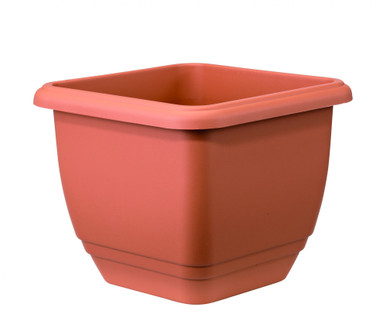
A self-watering planter has a built-in reservoir below the compost, so the plant draws up water as it needs it. For anyone who regularly travels, or who simply forgets, it is the most settled solution, and it is the one we would put first for a trip of a week or more.
A few points help you get the best from them:
- Pick plants that enjoy steady moisture. The RHS notes that self-watering containers suit plants that tolerate permanently moist conditions, and recommends them as a long-term growing solution. Think of leafy annuals, herbs such as mint and parsley, and many bedding plants.
- Fill the reservoir fully before you leave. A small reservoir can run dry, so size matters: a larger planter holds more.
- Plant into it a few weeks ahead. Roots need time to settle and find the water supply.
We have written a closer look at self-watering planters that refill every one to two weeks, which is useful if your trips are frequent and you want to know how often to top up. If you like the look of classic materials, our piece on terracotta versus plastic planters explains how the material changes how fast a pot dries.
For a row of pots or a patio, an automatic watering setup with a timer is another route. Hozelock automatic watering parts such as the 4mm flow control valve let you adjust how much water reaches each pot, so a thirsty fuchsia and a sun-loving geranium need not get the same amount.
7. Test your method before you go
This is the step people skip, and it is the one that saves the most plants. Which? Gardening Editor Ceri Thomas advises setting up your watering method a few days before leaving and checking that it delivers enough water and keeps the compost moist.
A simple rehearsal:
- Set up everything at least three or four days before your trip.
- Each day, check the compost below the surface and the water level in reservoirs.
- Adjust: more matting contact, a bigger reservoir, a looser or tighter valve.
- On the day you leave, confirm everything is still working, that nothing has blocked or tipped, and that every reservoir is full.
If a pot is still damp after several days on its own, the setup is working. If the leaves have started to droop, you have found the problem while you are still at home to fix it.
8. Match the method to the length of your trip
This table is our rule of thumb, based on the RHS guidance above and ordinary garden practice. Weather matters a great deal, so treat it as a starting point.
| Time away | What to do |
|---|---|
| 2 to 4 days | Water thoroughly, move pots into shade, group them |
| About a week | Add shallow saucers or capillary matting; fill any reservoirs |
| 1 to 2 weeks | Use self-watering planters or an automatic system you have already tested |
| More than a couple of weeks | Ask a trusted neighbour, friend or relative to check in, as well as any automatic system |
The RHS recommends asking someone to water your houseplants if you will be away longer than a couple of weeks. That advice holds for outdoor pots in summer too. Leave your helper clear instructions: which pots, how much, and which plants like a drier spell.
Why a good pot makes the difference
Self-watering planters and good drainage are only part of it. The pot itself decides how fast compost dries. Large pots hold more water than small ones. Glazed and stoneware pots lose less moisture through their walls than unglazed clay. A planter with a liner keeps the compost insulated from hot sides.
If you are choosing pots with holidays in mind, these are good places to start:
- The 33cm Essentials terracotta planter gives a roomy root space.
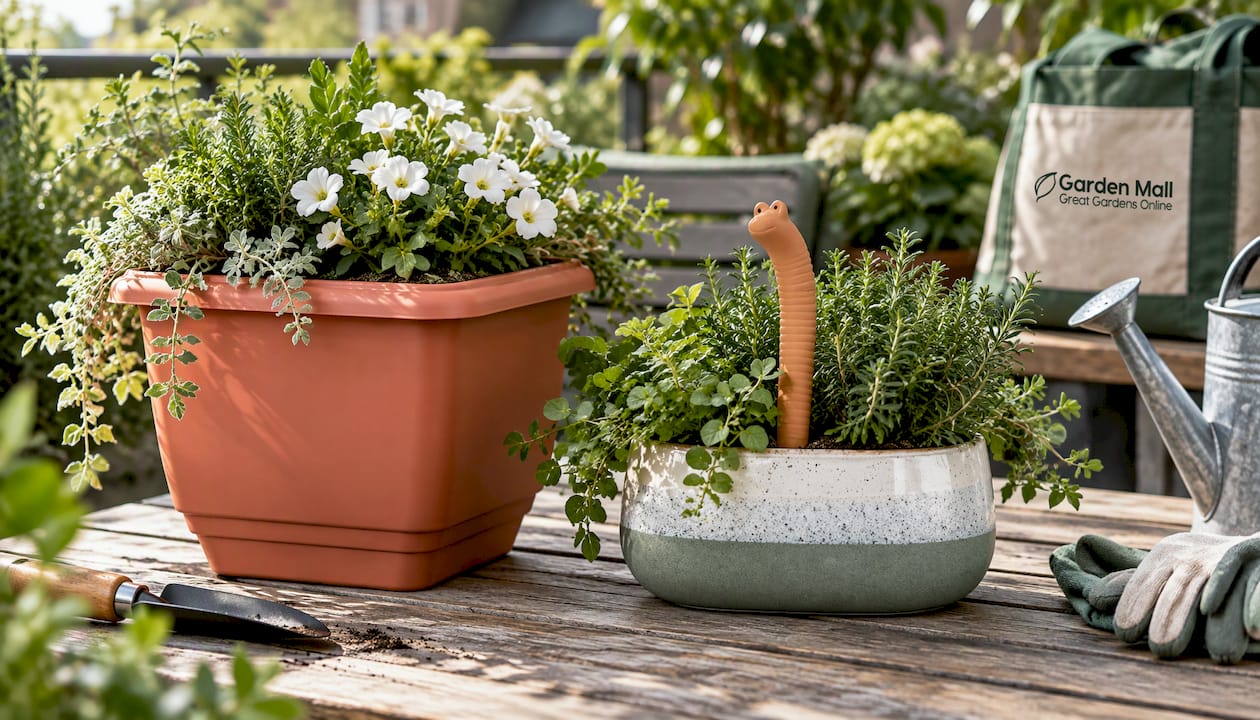
- The Hortus green and white Bordeaux stoneware pot suits a patio table or a sheltered corner.
- The metal raised garden planter with liner holds a much bigger volume of compost than a standard pot.
- A set of four Hortus cement-look planters is easy to group in one shaded corner.
If your pots sit in a shady spot, our guide to shade plants for pots shows which plants need less water to begin with.
Stock up before your next trip
We sell planters in terracotta, stoneware and contemporary finishes, plus watering accessories, so you can set up your pots ahead of a holiday in one order. Delivery is free on orders over £70, we offer next-day delivery options, and you can return items within 14 days. Browse the full range of outdoor pots and planters or start from our garden and outdoor living shop.
Our view: set it up once, enjoy the trip
We think the best holiday watering plan is the one you only have to build once. A pot that is large enough, a spot out of the afternoon sun and a reservoir you have tested will see you through most summer trips without anyone worrying about it.
That is why we put so many planters in the range, from classic terracotta to stoneware and raised planters with liners. A bigger pot is the simplest upgrade you can make for a plant that needs to look after itself for a week, and it stays useful on every ordinary day too.
Our advice to new homeowners and landlords is the same: choose pots with their water needs in mind, group them near the house, and do the test run. Then you can leave the garden looking good, whether it is your own or a rental that has to look welcoming to the next tenant.
Peter
FAQ
How do I keep plants watered while I am away?
Water thoroughly a day or two before you go, then move pots into shade and shelter and group them together. For a week or more, add saucers, capillary matting or a self-watering planter. Test whichever you choose a few days beforehand.
Should you water pots every day?
Not always. In hot, sunny weather small pots and hanging baskets may need water daily, because containers hold little moisture. In cool or cloudy weather a thorough soak can last several days. Check the compost 2 to 3 cm below the surface rather than judging by the top layer.
Why does water run straight through my plant pots?
Usually the compost has dried out and shrunk away from the pot wall, so water slips down the gap. Water slowly in two or three rounds, press the compost back against the sides, and for very dry pots stand them in a bowl of water for half an hour. The pot should feel heavier afterwards.
Are self-watering pots a good idea for holidays?
Yes, for the right plants. They suit plants that enjoy steady moisture, and a full reservoir gives you a steady supply while you are away. Size matters, so choose a generous reservoir and fill it just before you leave. Plant into it a few weeks ahead so roots settle in.
Sources
- How to look after your garden on holiday, RHS
- Houseplants: Holiday Care Tips, RHS Advice
- How to keep plants alive when on holiday, Which? Gardening
