



Screen Your Garden in One Season with Order Ready Privacy Trellis
Posted by Amy Hall on 8th Sep 2026
Screen Your Garden in One Season with Order Ready Privacy Trellis

For most small to medium gardens, a pressure-treated timber panel with a tight lattice or a powder-coated metal screen delivers the best mix of privacy, good looks and manageable upkeep. Pair either with a fast-growing evergreen climber and you get proper screening within a season or two. This guide covers materials, sizing, mounting, privacy levels, design and the maintenance that keeps it looking sharp for years.
TL;DR:
- Proper measurement of fence height, panel width, and clearance gaps is crucial to ensure a good fit and effective privacy.
- Timber requires re-staining every 1 to 2 years, while metal panels need minimal maintenance beyond occasional cleaning or scratch repairs.
- Tight lattice patterns with small gaps combined with evergreen climbing plants provide the most year-round privacy within a growing season.
- The choice of fixing type and accurate post-spacing is more important than material finish for lasting security and appearance.
- Custom orders, proper hardware, and adherence to local rules help avoid delays and ensure the trellis performs well over time.
Table of Contents
- Which trellis material gives the best privacy?
- How do you measure and mount a privacy trellis?
- How much privacy does a trellis actually give you?
- What design ideas make a privacy trellis look good, not just functional?
- How do you keep a privacy trellis looking good for years?
- What should you check before buying a privacy trellis?
- Expert tips and practical help from Great Gardens Online
- What most guides get wrong about trellis privacy
- Order your privacy trellis and accessories from Great Gardens Online
- Where to look for more privacy trellis inspiration
- Sources
Which trellis material gives the best privacy?
Your choice of material shapes both how much privacy you get and how much work you’ll put in afterwards. Each option behaves differently once it’s weathered a British winter or two.
Timber remains the most popular choice, and for good reason. Pressure-treated softwood resists rot for years, while cedar offers a naturally warmer tone and better resistance to insects without chemical treatment. Timber suits traditional gardens well but needs re-staining every couple of years to stay looking fresh.
Metal panels, particularly laser-cut steel or corten designs, have become the go-to for anyone who wants a contemporary look with minimal fuss. Laser-cut metal panels offer precise, decorative patterns and considerably less seasonal upkeep than timber, since there’s no staining or sealing involved.
PVC and composite panels are the low-maintenance option. They resist UV fading reasonably well and never need painting, though they can look and feel less substantial than timber or steel, and cheaper versions can warp in strong heat.
Decorative panels in corten steel develop an attractive rust-like patina over time and need almost no treatment once installed, whereas traditional lattice suits gardens where you want climbing plants to do most of the screening work.
- Timber: classic look, needs treatment every 1 to 2 years
- Metal (laser-cut or corten): modern finish, low seasonal maintenance
- PVC/composite: lowest upkeep, less traditional appearance
- Decorative panels: best for a design statement, pairs well with minimal planting
Pro Tip: If you’re torn between timber and metal, think about your fence line first. A run of cedar trellis looks lovely against brick, but a corten panel can make a plain rendered wall look intentional rather than bare.
How do you measure and mount a privacy trellis?
Getting the sizing right before you buy saves a wasted trip back to the supplier. Standing at your usual seating spot and checking the sightline into next door tells you the height you actually need, which is often taller than people assume, especially on a raised patio.
- Measure your existing fence height, then add the trellis height on top, checking it against your sightline rather than a generic “6 feet is standard” rule.
- For top-of-fence additions, confirm the post spacing matches your panel width, and leave a small clearance gap at the base for drainage and airflow.
- Choose your mounting method: bolt-on brackets for existing timber posts, wall brackets for masonry, or a freestanding wrought-iron screen where you can’t drill into a shared wall or rented boundary.
- Match fixings to the surface: coach screws for timber, resin anchors for masonry and concrete, and check the panel manufacturer’s recommended fixing type before buying hardware separately.
- Do a basic stability check. Taller panels catch more wind, so anything over 1.8 metres on an exposed boundary usually needs extra bracing or deeper post footings.
- Call a tradesperson for anything involving a shared boundary wall, retaining structures, or fixing into rendered or listed masonry. DIY the rest with confidence.
Decorative outdoor panels are commonly supplied with T-bar, U-bracket or freestanding base options, so check which hardware is included before assuming you’ll need to source it separately.
How much privacy does a trellis actually give you?
The answer comes down to gap size, not just height. A tight lattice pattern with narrow gaps blocks sightliness almost completely, while an open diamond pattern lets in more light and air but offers only partial screening on its own. Supplier listings commonly describe pressure-treated timber with lattice gaps around two to four centimetres as the standard for genuine privacy use, compared with wider decorative patterns meant more for climbing support than screening.
Planting closes the gaps that panel design leaves behind. A tighter lattice combined with suitable evergreen climbers gives you dense, year-round screening much faster than waiting for a wide-gapped trellis to fill in on its own.
- Small courtyard: tight lattice plus a single well-placed evergreen climber for near-total privacy in one growing season
- Side alley: narrower panels with dense lattice work well where space is tight and airflow still matters
- Large garden boundary: mix panel widths with taller backing plants so the screen doesn’t look like one long, flat wall
What design ideas make a privacy trellis look good, not just functional?
A screen that only blocks a view can end up feeling like a wall. The trick is treating it as a garden feature in its own right.
L-shaped or wraparound layouts avoid the boxed-in feeling that comes from enclosing a small patio on every side. Garden design guidance consistently warns that over-enclosing a small space is a common mistake, and that repeating panels with intentional gaps keeps air moving and avoids a claustrophobic corner.
- Arched-top panels soften a straight run of fencing and draw the eye upward rather than along a flat line
- Layering two panel heights, or overlapping sections slightly, adds depth without extra width
- Use trellis as a backdrop behind a bench or dining set, then let planting spill forward to blur the join
- Hide bins, compost bays or oil tanks behind a single decorative panel rather than a full run
- Match the finish colour to existing furniture or paving; a dark charcoal frame tends to disappear into planting, while white or pale grey stands out as a feature
How do you keep a privacy trellis looking good for years?
Maintenance needs vary a lot by material, and skipping it shortens the life of even a well-built panel.
Timber needs the most attention: reapply treatment or stain every 1 to 2 years and check the base posts for rot each autumn, since that’s where moisture collects first. Metal panels with a powder-coated finish need very little beyond an occasional wipe down, though scratches should be touched up before rust takes hold; corten steel is different again, as its rust-coloured patina is meant to develop and shouldn’t be treated or painted over. PVC and composite panels just need a rinse with soapy water a couple of times a year to clear algae and prevent UV-related dulling.
- Check all fixings and brackets each spring after winter winds have had a chance to loosen anything
- Look for splitting timber or lifting fence posts before they become a bigger repair
- Clear plant growth away from fixing points so moisture doesn’t sit against the panel
Pro Tip: Give bolts and brackets a quarter-turn check every spring, even if nothing looks loose. Winter gusts work fixings gradually, not all at once, and you’ll catch the problem long before a panel actually shifts.
What should you check before buying a privacy trellis?
Getting the order right the first time avoids delays and mismatched panels.
- Confirm exact dimensions against your measured space, including post width and any clearance gap needed at the base.
- Check the finish and treatment: pre-treated timber, powder-coated metal, or UV-stabilised composite all have different expected lifespans.
- Ask whether fixings and brackets are included or need to be bought separately, and whether cut-to-size options are available for awkward boundary lengths.
- Ask about lead times if you need a specific quantity of matching panels for a long boundary run.
- Check the warranty and returns policy before ordering, particularly for made-to-measure or custom-finish panels.
- Before fitting anything above standard fence height, check local planning rules on boundary structure heights and talk to your neighbour if the screen affects a shared wall or fence line.
Cost varies mainly by material and finish. Basic timber lattice panels sit at the budget end, powder-coated metal and corten sit in the mid-to-upper range, and fully custom decorative panels cost the most due to bespoke cutting and finishing.
Expert tips and practical help from Great Gardens Online
Most enquiries Great Gardens Online receives are for boundary runs between 1.8 and 3 metres, often ordered alongside planters to speed up screening while climbers establish. Delivery options, next-day shipping, and returns are available to help if a panel doesn’t quite fit once measured on site. If you need a custom size or have an urgent order ahead of a garden event, customer service can talk through options directly rather than leaving you guessing over specifications.
What most guides get wrong about trellis privacy
Most advice on this topic treats the trellis panel as the whole solution, when it’s really the framework a solution gets built on. A tight lattice bought and fitted correctly still won’t feel private for months if nobody plants anything against it, and a beautiful corten screen still needs proper fixings behind it or it becomes a hazard in the first autumn gale.
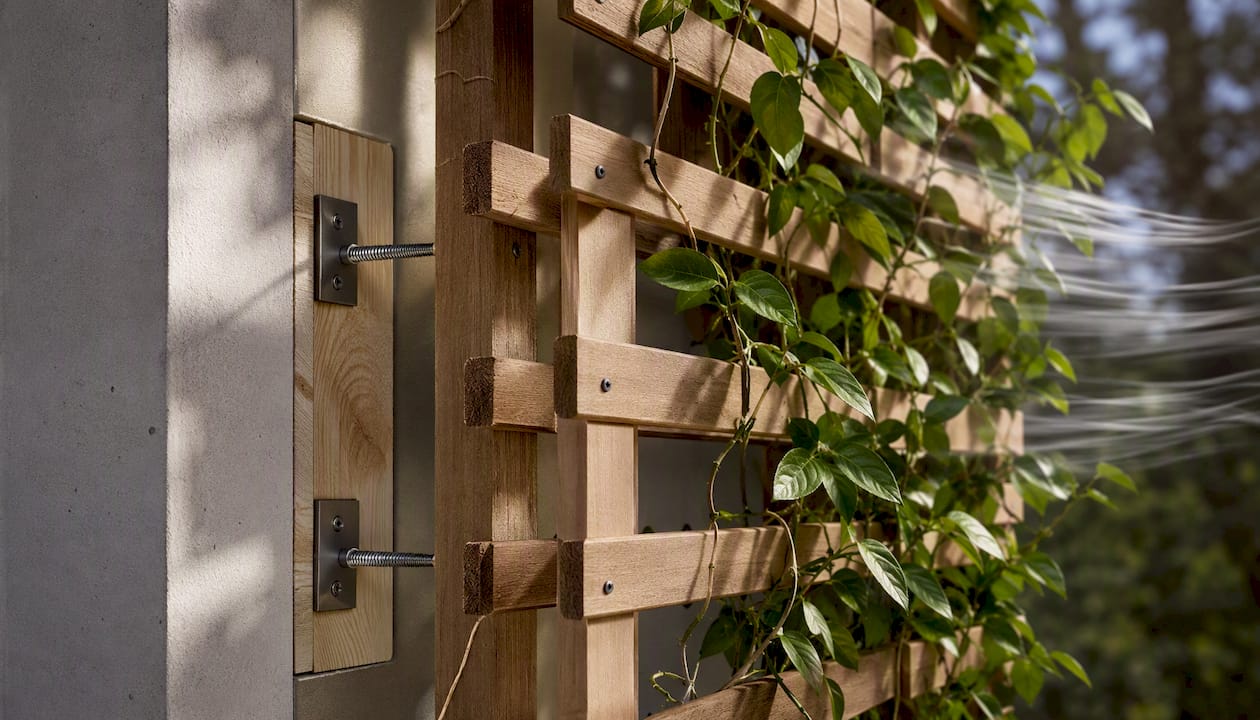
The conventional advice tends to overweight style and underweight the boring bits: gap size, fixing type, and whether the post spacing actually matches the panel. Get those wrong and no amount of good design saves the result. Get them right, and even a modest budget timber panel with the correct lattice gap and a single evergreen climber will outperform an expensive decorative screen fitted loosely to the wrong posts.
If there’s one thing to prioritise first, it’s measurement and fixing type, not finish. Decide those, then choose the material that suits your garden’s look.
— Peter
Order your privacy trellis and accessories from Great Gardens Online
This online store offers a range of trellis panels across timber, metal and decorative finishes, along with planters and mounting hardware, enabling customers to order everything needed for a boundary run in a single checkout.
Delivery options, including next-day, and returns are available if a panel needs swapping after proper measurement of your fence line. Pairing a trellis with a raised planter speeds up climber coverage considerably. If you want elevated planting alongside your screen, a galvanised steel garden planter gives climbers a solid, long-lasting base to establish from.
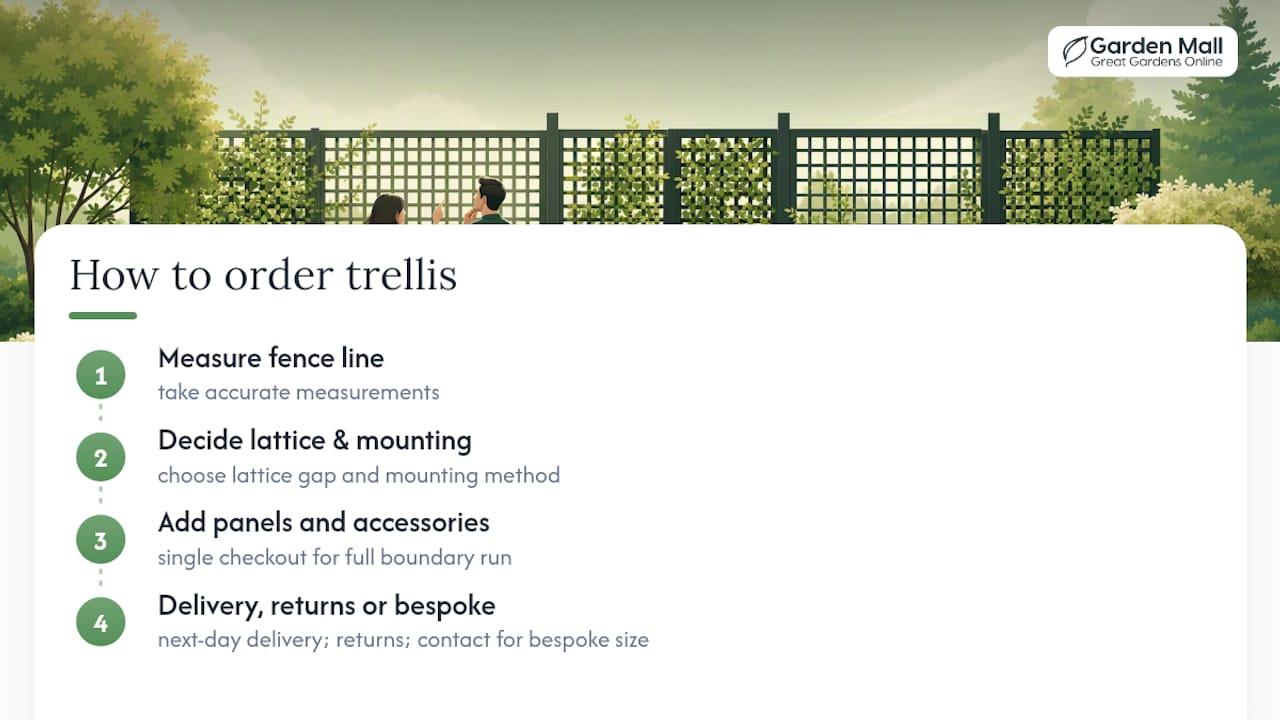
Measure your fence line, decide on lattice gap and mounting method using the checklist above, then head to the Great Gardens Online garden mall to order your panels or get in touch about a bespoke size.
Where to look for more privacy trellis inspiration
For design ideas, Better Homes & Gardens covers planting and layout options well. For decorative metal panels, So Corten shows corten finishes in situ. For fixing and installation detail, DIY.com’s fencing section is a solid reference.
