


Match Pots to Plants: UK planter sizes from 1–100+L
Posted by Amy Hall on 17th Sep 2026
Match Pots to Plants: UK planter sizes from 1–100+L
Work in centimetres and litres, since that’s how most UK retailers label stock, though inches and gallons crop up too. Trusted guidance from the RHS, the Almanac’s vegetable container chart, and Great Gardens Online’s own planter range all point to the same principle: match the pot to the plant’s growth stage, not just its current size.
TL;DR:
- Most planters are categorized into four size bands, with capacities ranging from 1 litre for small pots to over 100 litres for extra-large containers.
- Accurate measurement of diameter, depth, and capacity is essential, especially on tapered pots, to ensure the plant’s root space matches its growth stage.
- Plant choice determines ideal pot size; herbs usually require 15-30cm diameter pots, vegetables need 5-25 litres depending on the crop, and shrubs often need at least 70cm depth.
- Oversizing planters can cause waterlogging and instability, so avoid overpotting and focus on the plant’s current and future root needs.
- When selecting large planters, consider weight, space, and cost, with stability and structural load requirements especially important for balcony or rooftop placement.
Table of Contents
- What planter size guide categories mean in practice
- Pot size guide by plant type: herbs, veg, houseplants and shrubs
- How do you measure a pot to check its size?
- Does planter material affect the size you need?
- When is it time to upsize your planter?
- Planning for space, weight and cost before you buy
- A gardener’s honest checklist for getting planter size right
- Find the right size planter at Great Gardens Online
- Sources
- FAQ
What planter size guide categories mean in practice
Every planter you’ll come across in garden centres and online listings falls into one of four rough bands. Knowing them saves you squinting at product pages trying to work out whether a “30cm pot” will actually take your tomato plant.
- Small (10–20cm diameter / 1–5 litres): windowsill herbs, seedlings, and single small succulents.
- Medium (20–35cm diameter / 5–20 litres): trailing herbs, salad leaves, single pepper or chilli plants, and most houseplants once they’ve outgrown a starter pot.
- Large (35–60cm diameter / 20–100 litres): tomatoes, dwarf fruit trees, patio focal points, and shrubs that need to stay put for a few years.
- Extra-large (60cm+ diameter / 100+ litres): small ornamental trees, hedging in pots, and anything meant to anchor a patio or balcony scheme long term.
Diameter and depth don’t always scale together, so check both figures rather than assuming a wide pot is automatically deep enough. If you’re working from an American product description, roughly 4 litres equals 1 US gallon, and 1 inch is 2.5cm, which is close enough for planning purposes. UK retailers tend to list capacity in litres rather than diameter alone, so that’s the figure worth noting down when comparing options.
Pot size guide by plant type: herbs, veg, houseplants and shrubs
Different plants have wildly different root habits, so a single “average” pot size guide would mislead more than it helps. Here’s how the sizing actually breaks down by group.
- Herbs. Compact herbs like thyme and chives are happy in 15–20cm diameter pots, while bushier growers such as basil and mint want 25–30cm. Depth matters more than most people assume: RHS guidance recommends deeper “long tom” pots for herbs whose roots need a proper run, with 15–25cm depth as a sensible working range. As a rule of thumb, about one gallon of potting mix per herb plant supports healthy growth, and a 12-inch pot holding a moderate volume suitable for several herbs will comfortably support several herbs grouped together.
- Vegetables. This is where sizing really diverges by crop. The Almanac’s container chart shows indeterminate tomatoes wanting 15–25 litres in a 40–60cm pot, while compact determinate varieties manage in 30–40cm containers. Peppers need far less, typically 5–10 litres in a 20–30cm pot. Root crops and cut-and-come-again salad leaves get away with shallower, smaller containers since they’re not chasing depth the way tomatoes are.
- Houseplants. The usual mistake is sizing the decorative outer pot to the plant’s height rather than its nursery pot. Go up one size from the plastic nursery pot it arrived in, and resist the urge to jump two or three sizes “to save repotting later” — oversized pots hold excess moisture around roots that aren’t yet using that space.
- Perennials, shrubs and small trees. These need real root volume to establish. Aim for at least 70cm depth for small shrubs and young trees destined to stay in a container for several seasons, giving roots room to anchor the plant properly.
How do you measure a pot to check its size?
Measure three things before buying: the mouth diameter, the usable depth (not the total height, since some of that is often taken up by drainage material), and the stated capacity if one’s listed. Rim diameter and base diameter can differ noticeably on tapered pots, so measure at the top where the rootball actually sits.
Nursery labelling can be confusing at first glance. A pot marked “9cm” or “P9” refers to its diameter, roughly equivalent to a 0.5 litre capacity, while a “2 litre” pot is usually around 14–16cm across. When you’re sizing up from a nursery pot to a decorative planter, match diameters first, then check the decorative pot’s depth is at least equal to the nursery pot’s.
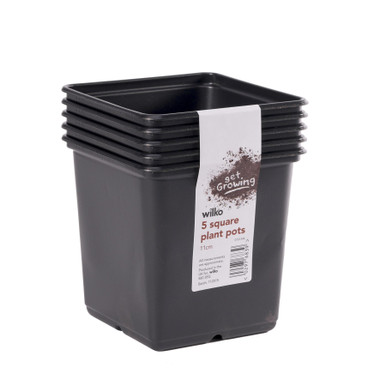
Quick conversions: 16 inches is about 41cm diameter; 12 inches about 30cm; 8 inches about 20cm. Capacity depends on pot shape and depth, so these are approximate sizes.
These are approximate mappings rather than fixed conversions, since pot shape affects how diameter translates to actual litre capacity, so treat them as a sense check rather than gospel.
Does planter material affect the size you need?
Drainage becomes more critical as pot volume increases, simply because a bigger reservoir of compost holds more water for longer if it can’t escape. Every planter, regardless of size, needs proper drainage holes and ideally a drainage layer of grit or broken crockery at the base to stop those holes clogging with compost over time.
Material changes how forgiving that size choice is. Terracotta is porous and dries out faster, which suits plants that hate wet feet but means more frequent watering in a large pot. Plastic and resin planters retain moisture longer, useful for reducing watering chores but riskier for waterlogging if drainage is poor. Self-watering planters manage moisture more evenly, though very large self-watering units can still develop soggy patches at the base if the reservoir is oversized for the plant.
Stability is the other size-driven concern. A tall, narrow planter filled with wet compost has a high centre of gravity and can topple in wind, especially on an exposed balcony or roof terrace.
Pro Tip: Before committing to a tall, slender planter for a windy spot, weigh down the base with a layer of gravel beneath the substrate. It lowers the centre of gravity without eating into root depth.
When is it time to upsize your planter?
Four signs reliably signal a plant has outgrown its pot: roots visible at the drainage holes or circling the surface, compost drying out within a day or two of watering, noticeably slower growth despite the season, and water running straight through without the compost seeming to hold any.
When you do upsize, one size up giving 20–50% more root volume suits most established plants. Young transplants and seedlings can handle a slightly bigger jump, since the extra soil volume supports faster early root development without the plant needing to fill the whole pot immediately.
A simple repotting checklist:
- Choose the new pot using the sizing rules above, checking both diameter and depth.
- Gently loosen any tightly circling roots so they can spread into fresh compost.
- Add fresh potting mix, firming lightly around the rootball without compacting it.
- Water in thoroughly straight after repotting.
- Hold off on fertiliser for about two weeks while roots settle into the new space.
Planning for space, weight and cost before you buy
Before ordering a large planter, mark out its footprint with tape or an old box in the intended spot. It’s the easiest way to catch a size mistake before it arrives on a pallet.
Weight matters more than most gardeners expect. Damp potting substrate weighs roughly 1 to 1.5kg per litre once watered in, so a 100 litre planter can carry well over 100kg once filled and planted. On balconies or roof terraces, that’s worth checking against your building’s load guidance, and a structural specialist is worth consulting for anything genuinely oversized on an upper floor.
Cost isn’t purely about the planter itself, either. Substrate and delivery both scale with volume, so for borderline cases, two or three medium pots often work out more practical and cheaper than one extra-large one, and they’re easier to rearrange if your layout changes.
A gardener’s honest checklist for getting planter size right
Don’t overpot. It’s the single most common mistake, and it leaves compost waterlogged around roots that aren’t yet big enough to use it. Do favour depth over width for taproot herbs like parsley, and keep mint in its own pot always, since it spreads aggressively given the chance. For a patio focal point, I’ve found it’s worth sizing up earlier than feels necessary. A shrub that looks slightly lost in a large pot on day one fills that space within a season.
— Peter
Find the right size planter at Great Gardens Online
Once you know the litres, diameter, and depth your plant needs, the next job is finding a planter that actually matches without a lengthy search. This retailer stocks planters across the full range covered in this guide, from compact herb pots to extra-large patio planters, with clear size details listed on each product page so you’re not left guessing from a photograph.
Orders over a qualifying amount may come with free delivery, and if a planter turns out to be the wrong size once it’s in front of you, returns are straightforward rather than a fight. That matters most with larger planters, where getting it wrong means shifting a heavy, filled pot rather than a quick exchange. Browse the full planter range at Great Gardens Online and filter by size to find the right fit for your space before you order.
Sources
- Almanac
- Growing herbs in containers | RHS
- Growing herbs in containers — USU extension
- Choosing the Right Planter Size: Complete Guide | Doika
FAQ
What are the standard sizes of plant pots in the UK?
UK retailers typically group planters as small (1–5 litres), medium (5–20 litres), large (20–100 litres), and extra-large (100 litres and above), usually labelled by litre capacity rather than diameter alone.
How big is a 16-inch planter?
A 16-inch planter measures roughly 41cm in diameter, which usually works out to somewhere between 30 and 40 litres capacity depending on its shape and depth.
