


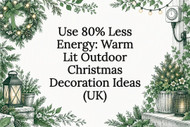
Use 80% Less Energy: Warm Lit Outdoor Christmas Decoration Ideas (UK)
Posted by Amy Hall on 27th Sep 2026
Use 80% Less Energy: Warm Lit Outdoor Christmas Decoration Ideas (UK)

The most effective outdoor Christmas displays focus on just one to three well-chosen spots rather than covering the whole garden. Pick warm-white, outdoor-rated LEDs, add a little quality greenery, and get the safety basics right from the start. Timers keep your electricity use sensible, and the whole thing looks deliberate rather than thrown together.
TL;DR:
- Focus on one or two anchor points and limit your color palette to two or three shades plus one metallic to create a cohesive display.
- Use warm-white LED lights with an IPX3 rating or higher, and always connect them through an RCD-protected socket with timers set for about eight hours daily.
- Choose durable outdoor decor like faux greenery, resin figures, or metal planters, and secure decorations with proper fixings to withstand wind and rain.
- Store decorations carefully in labeled, dry containers, remove batteries, and perform repairs during packing to ensure longevity for future seasons.
- Prioritize quality, weatherproof materials over cheap decorations, and add natural accents like pinecones to achieve an edited, stylish outdoor Christmas look.
Table of Contents
- 1. Start with a plan: anchor points, theme and palette
- 2. Lighting: choose warm-white LEDs, check IP ratings and use timers
- 3. Greenery and texture: garlands, wreaths, planters and natural accents
- 4. Statement features and focal vignettes that earn their place
- 5. Balancing colour and texture: edited maximalism in practice
- 6. Practical outdoor considerations: safety, installation and weatherproofing
- 7. Sustainable choices: LEDs, solar accents and timers to lower running costs
- 8. Bringing it together: a step-by-step front-door vignette
- 9. Selecting decorations based on weather durability and local climate conditions
- 10. Tips for installing decorations securely to withstand wind and rain
- 11. Storage solutions and maintenance tips for outdoor decorations after the season
- 12. Why a focused, quality-led display works better long term
- 13. Where to find the pieces for your display
- Sources
- FAQ
1. Start with a plan: anchor points, theme and palette
Before you buy a single string of lights, walk round your house and note the spots that already draw the eye: your front door, a porch, the windows either side of it, the path leading up to your gate. These become your anchor points, and measuring them now saves you buying the wrong length of garland later.
Pick a theme you can commit to, whether that’s rustic woodland, classic red and gold, or a cooler silver and white scheme, and keep it to two or three colours. This is what separates a display that reads as considered from one that looks like a jumble sale of leftover tinsel.
- Measure your door width, porch height and path length before shopping.
- Choose two or three colours and stick to them across lights, ribbons and baubles.
- Prioritise one or two anchor points rather than spreading effort thinly.
- Set a simple budget so greenery, lights and statement pieces don’t creep out of control.
2. Lighting: choose warm-white LEDs, check IP ratings and use timers
Your lighting choice does more work than anything else in an outdoor display, so it’s worth getting right. LEDs typically use around 80% less energy than halogen bulbs, which makes them the sensible choice whether you’re lighting one wreath or an entire front garden.

Around 80% less energy use is what you gain by choosing LEDs over halogen lighting, meaning you can run a display for the whole festive season without dreading the electricity bill.
For that warm, glowing look, aim for a colour temperature of roughly 2200K to 2700K, which gives a candlelike quality rather than the cold blue-white of some cheaper sets. Before you buy, always check the packaging for a waterdrop symbol or an IP code. Electrical Safety First recommends a minimum of IPX3 for anything exposed to rain, and transformers or plugs should stay indoors regardless of how weatherproof the light chain itself claims to be.
- Choose warm-white LEDs in the 2200K to 2700K range for a cosy glow.
- Look for a waterdrop symbol or an IP code of at least IPX3 before buying.
- Keep transformers and plugs indoors, even on outdoor-rated sets.
- Use timers, smart plugs or solar accents so lights aren’t running all night.
3. Greenery and texture: garlands, wreaths, planters and natural accents
Greenery gives your display substance in daylight, when the lights aren’t doing any work at all. Real foliage such as fir or holly smells wonderful and looks naturally full, but it needs watering and will brown over several weeks. Good-quality faux garlands cost more upfront but last for years and hold their shape in wind and rain far better than fresh cuttings.
A pair of matching planters flanking your front door, filled with evergreens and a few trailing stems, instantly frames the entrance. Add pinecones, birch logs or a textured ribbon for depth, and weave a thin string of fairy lights right through the greenery itself rather than just draping lights over the top.
- Choose real greenery for scent and fullness, or quality faux for durability across the season.
- Flank the door with matching planters filled with evergreens for an instant frame.
- Add pinecones, birch logs or textured ribbon to build visual depth.
- Weave fairy lights into the garland itself so the glow comes from within, not just from outside it.
Pro Tip: Twist two thinner garland strands together, or layer a slim strand over a bulkier faux base, to get the look of a premium garland without paying premium prices.
4. Statement features and focal vignettes that earn their place
A handful of well-scaled statement pieces will do more for your kerb appeal than dozens of small decorations scattered across the garden. The trick is choosing features that are visible from the street and giving each one room to breathe.
- A large front-door wreath sets the tone immediately and works with almost any theme.
- A vertical light tree beside the porch adds height without needing a real tree.
- Illuminated planters either side of the entrance echo your greenery scheme after dark.
- Clustered lanterns along a path or windowsill create a budget-friendly focal point using battery LEDs.
Scale each piece to the space: a wreath that looks generous close up can vanish from the pavement, so err on the larger side for anything meant to be seen from a distance.
5. Balancing colour and texture: edited maximalism in practice
The strongest displays in 2026’s outdoor decor trends lean towards a tighter, more curated look rather than covering every surface. This edited maximalism means picking two or three colours and one metallic accent, then repeating them consistently across lights, ribbons and baubles so nothing feels random.
Texture becomes especially important once the lights switch off during the day. Rough bark, woven ribbon and matte ornaments hold visual interest even without illumination, which is why natural materials pair so well with the warm-lit woodland approach.
- Limit your palette to two or three colours plus one metallic, such as brushed gold or copper.
- Coordinate ribbons and baubles with your main lights and greenery rather than treating them separately.
- Layer different textures, smooth, rough, woven, so the display still looks intentional with the lights off.
6. Practical outdoor considerations: safety, installation and weatherproofing
Before you plug anything in, check every light chain and cable for cracks, fraying or exposed wire, and replace any set that looks damaged rather than patching it up. Electrical-safety guidance is consistent on this point: outdoor-rated chains alone don’t make a whole installation safe, because plugs, transformers and connections are usually where problems start.
Only use products carrying the waterdrop symbol or an IP code, aiming for at least IPX3 wherever rain is likely to reach them. Connect everything through an RCD-protected socket. Electrical Safety First notes that a plug-in RCD adapter is an affordable option if your consumer unit doesn’t already have one built in.
A 30mA RCD-protected socket is the standard safety measure recommended for outdoor Christmas lights, and a plug-in adapter is a low-cost way to add that protection if you don’t already have it.
- Inspect every cable and light set before use, and bin anything damaged.
- Only buy outdoor-rated products marked with a waterdrop symbol or IP code.
- Connect via a 30mA RCD-protected socket, or add a plug-in RCD adapter.
- Avoid overloading sockets, and secure cables with gutter clips or purpose-made hooks rather than nails or staples.
7. Sustainable choices: LEDs, solar accents and timers to lower running costs
Switching old halogen sets for LEDs is the single biggest change you can make to your running costs, given LEDs use around 80% less energy for the same visual impact. Pairing that with a timer set to roughly eight hours a day, rather than leaving lights on overnight, cuts consumption further without you having to remember to switch anything off.
The Energy Saving Trust also suggests solar fairy lights as a good option for spots that get reasonable daylight, though they’re less reliable through short, overcast winter days and work best as accent lighting rather than your main light source.
- Replace halogen sets with LEDs for the biggest single reduction in running costs.
- Use a timer for around eight hours a day rather than leaving lights on overnight.
- Reserve solar lights for sunnier spots and treat them as accents, not your main lighting.
- Store lights carefully at the end of the season so they last for several more Christmases.
8. Bringing it together: a step-by-step front-door vignette
Here’s a simple sequence to follow for one complete, street-visible display around your front door.
- Measure the door, porch and path so you know exactly how much garland and how many lights you need.
- Choose your palette, two or three colours plus one metallic accent, and buy everything against that plan.
- Fix a wreath to the door and flank it with matching planters filled with evergreens.
- Weave warm-white LED lights through the greenery and wreath before hanging anything.
- Connect everything through an RCD-protected socket and set a timer for the evening hours.
- Test the whole display at dusk, adjusting spacing and brightness before you commit to the final layout.
Pro Tip: Route cables along the inside edge of a doorframe and secure the plug or transformer just inside the porch, out of the rain, so nothing sits exposed on the step.
9. Selecting decorations based on weather durability and local climate conditions
What survives a mild, sheltered garden won’t necessarily survive an exposed one, so it’s worth matching your choices to your own conditions. A porch tucked under an overhang can support lighter, more delicate decorations, while an open front garden that catches wind and rain needs sturdier materials throughout.
Faux greenery made from UV-stabilised plastic holds its colour far better than budget alternatives, which tend to fade or turn brittle after a few frosty spells. Metal or resin figures cope with damp far better than untreated wood, which can swell, warp or grow mould if left outside for weeks on end. If you’re set on natural materials like birch logs or pinecones, choose a sheltered spot such as under a porch roof or against a wall, rather than out in open ground.
Wind matters as much as rain. Tall or top-heavy pieces, such as light trees or standing figures, need a wide, weighted base or a secure fixing point, otherwise the first proper gust will have them on their side. Lightweight decorations like paper stars or thin ribbon bows are best reserved for sheltered porches rather than an exposed front path, where they’ll quickly look tired or simply blow away.
If your garden faces a lot of driving rain, prioritise anything with a solid IP rating over decorative appeal alone, since a beautiful light chain that fails after one wet week isn’t much of a bargain.
10. Tips for installing decorations securely to withstand wind and rain
Good installation matters just as much as good products. Start with fixings: gutter clips, purpose-made light hooks and cable ties are far more secure than nails, staples or tape, and they won’t damage guttering or brickwork in the process.
For garlands and wreaths, anchor them at multiple points rather than relying on a single hook. A wreath hung from one nail will swing and twist in the wind, whereas one secured with a ribbon loop and a discreet screw eye stays put through a proper storm. The same logic applies to light trees and standing figures: a wide, weighted base, or guy lines pegged into the ground, stops them toppling.
Cables should be routed so that water naturally runs away from plugs and connectors rather than pooling at them. Where a cable has to cross open ground, keep it off wet grass using cable covers or by running it along a fence line, and always leave a drip loop, a small downward dip in the cable, before it reaches any plug or socket, so water travels away from the connection rather than into it.

Check your fixings a few days after the first proper installation, since wind can loosen ties and clips faster than you’d expect. A five-minute check after a windy night is far easier than replacing a decoration that’s been dragged across the lawn.
11. Storage solutions and maintenance tips for outdoor decorations after the season
How you pack decorations away has a big effect on how well they survive to next Christmas. Wind light chains around a cardboard reel, a piece of foam pipe insulation or a purpose-made cable holder rather than looping them loosely into a box, since tangled cables are far more likely to develop kinks and breaks in the wire over time.
Wipe down planters, figures and lanterns before storing them, especially anything that’s been in contact with soil or mud, so they go away clean rather than staining other stored items. Faux greenery benefits from a gentle shake and brush to remove debris, then storage somewhere dry, since damp storage is one of the main reasons artificial garlands start to smell musty or lose their shape.
Label your storage boxes by decoration type or by which part of the display they belong to, front door, path, planters, so next year’s setup takes minutes rather than an afternoon of sorting. A cool, dry loft, shed or under-stairs cupboard suits most decorations well, though anything with batteries should have them removed before a long spell in storage to avoid corrosion.
Finally, do a quick repair check as you pack away rather than waiting until next December: a loose bauble hook or a slightly frayed ribbon is a five-minute fix now, and a forgotten annoyance next year.
12. Why a focused, quality-led display works better long term
A handful of well-chosen pieces, a good wreath, a solid pair of planters, an outdoor-rated light set, will outlast a box of cheap decorations bought on impulse. Quality garden decor and outdoor pots and planters are built with longevity in mind.
Free delivery on orders over a certain amount and straightforward returns make it easier to build your display gradually, testing what works before committing further.
— Peter
13. Where to find the pieces for your display
If you’re ready to put this plan into action, Outdoor living ranges cover most of what’s mentioned here, from paired planters to garden decor pieces that suit a warm-lit woodland scheme.
- Garden Decor for wreaths, lanterns and statement ornaments.
- Outdoor Pots & Planters for the paired planters that frame a front door.
- Garden Furniture, Landscaping & Structures, Home & Gift for the wider range of seasonal outdoor pieces.
Orders over a certain amount come with free delivery, and returns are straightforward if something doesn’t suit your space. Browse the categories above and start with the anchor point that matters most to you.
Sources
For further guidance, see Electrical Safety First’s Christmas lights advice and the Energy Saving Trust’s lighting advice.
- Electrical Safety Advice for Christmas Lights
- Energy-efficient lighting guidance
- Christmas energy-saving tips
FAQ
What are some good Christmas decorations for outside?
A well-lit wreath, warm-white LED lights woven through greenery, and a pair of matching planters flanking the front door make a strong, simple display. Adding one statement feature, such as a vertical light tree, gives the whole scheme a clear focal point.
What are some good decorations to use outside for Christmas?
Outdoor-rated LED lights, faux or real garlands, wreaths and weatherproof planters all work well, provided lights carry a waterdrop symbol or an IP code rated at least IPX3. Natural accents like pinecones and birch logs add texture without needing electricity at all.
How can I tastefully decorate outside for Christmas?
Stick to two or three colours plus one metallic accent, concentrate your effort on one or two focal points rather than the whole garden, and choose warm-white lighting in the 2200K to 2700K range for a cosy glow. This edited approach reads as considered rather than cluttered.
What is the outdoor Christmas decor trend for 2026?
The 2026 trend leans towards edited maximalism, meaning a tight colour palette, natural textures and a few concentrated vignettes rather than covering every surface. Warm-white lighting and quality greenery are central to this warm-lit woodland look.
Are outdoor Christmas lights waterproof?
Not automatically. Outdoor lights need a waterdrop symbol or an IP code, with Electrical Safety First recommending at least IPX3 for rain exposure, and transformers or plugs should always stay indoors regardless of the light chain’s own rating.
