


Avoid Leaks: Gas BBQ Setup for UK Beginners, 1m Clearance
Posted by Amy Hall on 20th Sep 2026
Avoid Leaks: Gas BBQ Setup for UK Beginners, 1m Clearance
Your gas BBQ setup follows one safe order: assemble and site the barbecue properly, fit the correct EN 16129 regulator and hose, leak-test every joint with soapy water, then run a high-heat burn-off before you season the grates. Skip a step and you risk gas pooling under the lid, which is how Gas Safe Register call-outs and Liquid Gas UK incident reports so often start.
TL;DR:
- Properly positioned on a level, non-combustible surface with at least one meter clearance from walls and foliage reduces first-use fire hazards.
- Using a regulator with EN 16129 markings and replacing it once it exceeds its service life is essential for maintaining safety and preventing leaks.
- Leak testing with soapy water before any ignition, after cylinder changes, and monthly during the season ensures the integrity of joints and prevents potentially dangerous leaks.
- Ignition should follow the manufacturer’s instructions, running burners on high for ten to fifteen minutes to burn off residues before seasoning the grates if manual permits.
- Always store cylinders outdoors upright in well-ventilated areas, and avoid storing or working on the barbecue in enclosed spaces to prevent carbon monoxide buildup.
Table of Contents
- What you need before you start
- Where should you position your gas BBQ?
- Assembling your barbecue and cold checks
- Connecting the regulator and hose correctly
- How do you leak-test a gas BBQ before first use?
- First ignition, burn-off, and seasoning your grates
- Shutting down and storing your BBQ safely
- What beginners get wrong (and why it matters)
- Everything else you need for the season
- Sources
- FAQ
What you need before you start
Before you touch a spanner, lay everything out. Half-finished setups are how corners get cut, and corners are exactly where leaks happen.
- The barbecue unit and its printed owner’s manual
- A correctly sized LPG cylinder, either propane or butane, matched to your appliance’s gas type
- A compatible regulator and hose bearing EN or BS markings
- Leak-detection solution or a simple mix of washing-up liquid and water
- A basic spanner set sized to your fittings, plus heat-resistant gloves
- Long-handled tongs or lighters, and a fire blanket or extinguisher nearby
Do not improvise fittings with plumbing parts, and never use an indoor-rated cylinder or an unmarked regulator you cannot identify. Regulators wear out. Liquid Gas UK’s guidance recommends replacing them once they pass their stated service life, and buying second-hand is a false economy when the part costs so little against the risk.
Where should you position your gas BBQ?
Siting your barbecue wrongly causes more first-use problems than any wiring or connection fault. Set it up on a level, non-combustible surface such as paving or concrete, never decking, gravel that shifts, or grass.
Keep a clearance of at least a metre from walls, fences, and overhanging foliage, and never barbecue under a car port, gazebo roof, or anything that traps fumes. Enclosed spaces let carbon monoxide build up fast, which is exactly why Gov insists cylinders stay outdoors and ventilated at all times.
- Position the cylinder beside, not underneath, the barbecue
- Keep a clear exclusion zone for children and pets
- Check wind direction so flare-ups and smoke drift away from seating
- Confirm the surface won’t wobble once the barbecue is loaded
Pro Tip: Test the ground with the empty barbecue first. If a trolley-mounted unit rocks on paving slabs before you’ve even lit it, it will be far worse once the cylinder and full grill plate are loaded on top.
Assembling your barbecue and cold checks
Follow the manufacturer’s manual over any generic sequence, including this one. Gas BBQ setup steps differ between cabinet models, portable units, and built-in kitchen islands, and the manual reflects your specific ignition system and burner layout.
- Unpack and lay out every part against the parts list before starting
- Assemble the frame, side tables, and burner tray in the order the manual specifies
- Fit the grate and check it sits flush without rocking
- Inspect the burners, control valves, and hose for cracks, kinks, or corrosion
- Check the data plate to confirm the gas type matches your cylinder, as propane and butane appliances are not interchangeable
Use a properly sized spanner on gas fittings rather than pliers, which slip and round off the nut. Tighten firmly but do not over-tighten. A joint that needs excessive force usually has a thread or seal problem that a leak test will catch anyway.
Connecting the regulator and hose correctly
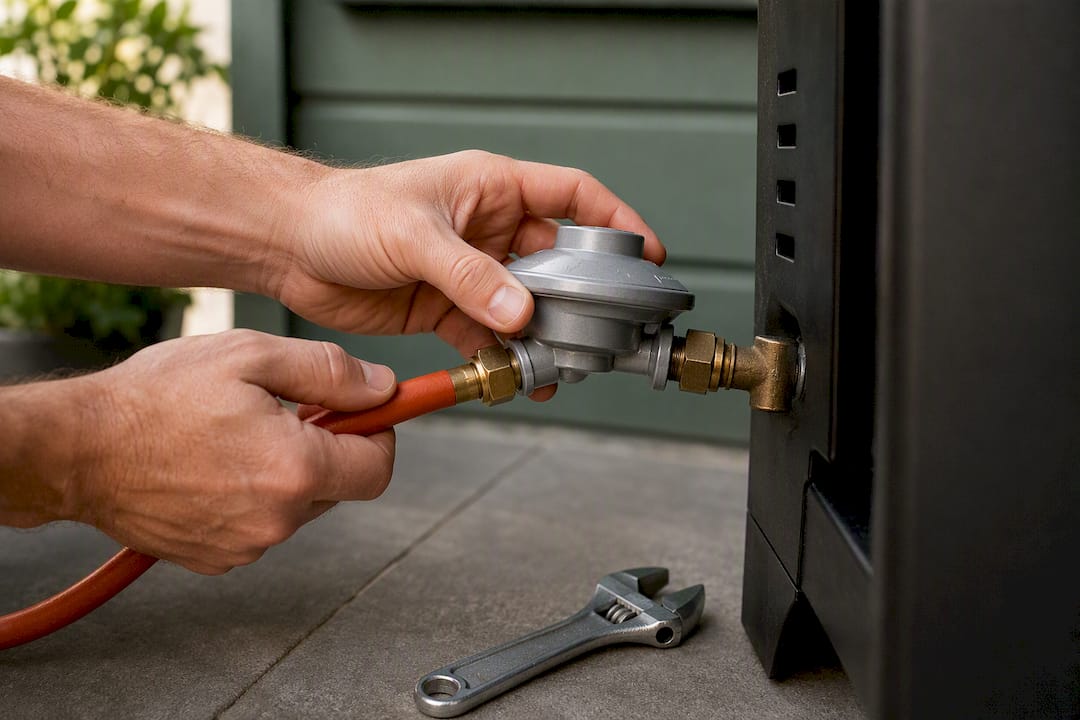
Regulator choice is where most new owners get gas BBQ setup wrong. UK domestic LPG regulators are typically preset: roughly 28 to 30 mbar for butane and around 37 mbar for propane, and Liquid Gas UK’s Consumer Guidance Sheet 39 recommends choosing regulators that carry EN 16129 markings so you know they meet current safety standards.
Fit the regulator with the correct orientation, screwing it onto the cylinder valve by hand until it seats, then check it sits square before connecting the hose. The regulator’s vent must never point upwards, and the hose should slope downwards from regulator to cylinder, reducing the risk of water or condensation running back into the mechanism.
- Never force a regulator onto a cylinder valve it wasn’t designed for
- Replace hoses showing cracking, perishing, or softness anywhere along their length
- Swap out regulators once they’ve exceeded their manufacturer’s stated service life
Many appliances sold in the UK are approved for a 37 mbar propane supply, and where you’re running a fixed installation or multiple cylinders, an OPSO device (Over Pressure Shut Off) adds a useful layer of protection against pressure surges.
How do you leak-test a gas BBQ before first use?
Never skip this step, and never test for leaks with a lit flame.
- Make sure the barbecue is completely cold and every valve is closed
- Open the cylinder valve slowly, just a quarter turn to start
- Brush soapy water or an approved leak-detection solution over every joint: cylinder connection, regulator, and hose fittings
- Watch for bubbles that grow, or listen for hissing
- If nothing appears after a minute or two at each joint, you’re clear to proceed to ignition
If you spot bubbles or smell gas, close the cylinder valve immediately, move away from any ignition source, and ventilate the area. Do not attempt to light the barbecue. Tighten the joint, check the washer or seal, and repeat the whole test from step one. Sometimes tightening harder isn’t the fix. If a regulator or hose has the wrong fitting type, no amount of force will seal it, and the part needs replacing.
Repeat this test before every first use, after any cylinder change, and as part of a monthly visual check through the barbecue season.
Pro Tip: Keep the soapy water in a small spray bottle by your barbecue store. It takes thirty seconds to retest after swapping a cylinder, and that thirty seconds is cheaper than any alternative.
First ignition, burn-off, and seasoning your grates
Follow your manual’s exact ignition sequence, since piezo igniters, rotary starters, and manual lighting all need slightly different handling. Most manufacturers recommend running all burners on high for ten to fifteen minutes on first ignition, which burns off manufacturing residues and protective coatings. You’ll see some smoke and possibly a slight odour. That’s normal, and it should fade as the burn-off completes.
Seasoning comes after burn-off, not instead of it, and only where the manual allows it. Bare cast iron grates benefit from a very thin film of cooking oil wiped on while warm, which helps build a non-stick surface over time. Enamelled or ceramic-coated grates are different. Check first, as oiling these can damage the coating rather than protect it.
- Preheat with the lid down for five to ten minutes before your first cook
- Choose forgiving first-cook foods such as sausages or vegetables that tolerate strong initial heat
- Watch for flare-ups during burn-off and keep the lid propped rather than fully closed
Shutting down and storing your BBQ safely
Turn off the cylinder valve first, then work through the appliance’s own shutdown sequence for the control knobs. This order matters because it burns off any gas left in the hose rather than trapping it.
Let the barbecue cool completely outdoors before you cover it or wheel it into storage. Covering a warm barbecue traps moisture and speeds up rust on burners and grates.
- Store cylinders upright, outdoors, in a well-ventilated spot away from doors and drains
- Never store cylinders in sheds, basements, garages, or anywhere enclosed, in line with Gov
- Return empty cylinders to your supplier rather than binning them
- Check hoses and regulators visually once a month, or at the start of each new season
- Bring in a Gas Safe registered engineer for any fixed installation work, since HSE guidance makes this a legal requirement, not just a recommendation
What beginners get wrong (and why it matters)
Most first-use accidents I’ve read about trace back to the same handful of shortcuts: skipping the leak test because “it’s a new hose, it’ll be fine,” oiling a coated grate the manual explicitly warns against, or storing a cylinder in a shed over winter because it’s out of the rain. None of these feel reckless in the moment. They’re small compromises that stack up.
The manual beats every generic guide, including this one, because your specific appliance may vary. Barbecues and outdoor dining sets designed to support a careful first-use process are available from various retailers, often with delivery and returns support if a part arrives faulty. A ten-minute leak test isn’t a chore. It’s the difference between a good summer and a call-out.
— Peter
Everything else you need for the season
If your leak test or cold check turned up a worn hose, a cracked grate, or you simply need better tools before you light up, our barbecue and outdoor dining range covers the gaps: fitted covers, heat-resistant grill tools, and replacement accessories sit alongside the barbecues themselves.
Beyond the BBQ itself, an outdoor dining set turns your first cook into an actual occasion rather than plates balanced on knees, and a chiminea or heater keeps the evening going once the grill’s cooled and covered. Some retailers offer free delivery on orders over a certain amount, next-day delivery on in-stock items, and 14-day returns policies for items that arrive faulty or incorrect. Browse the range and get everything sorted before the weekend, not the morning of.
Sources
- Gov
- Consumer Guidance Sheet 39 — Liquid Gas UK
- LPG safety in the spotlight: pressure regulators — NCASS
Always check your appliance manual first, and call a Gas Safe registered engineer for any fixed or built-in installation work.
FAQ
How do I light a gas BBQ for the first time?
Open the cylinder valve, follow your manual’s specific ignition sequence for your burner type, then run all burners on high for ten to fifteen minutes to burn off factory coatings. Always leak-test every joint before this first ignition, never after.
How do I season a new gas BBQ for the first time?
Season only after the initial burn-off, and only if your manual allows it. Bare cast iron grates take a thin film of oil wiped on while warm; enamelled or ceramic-coated grates usually shouldn’t be oiled at all, so check the manual first.
What do I need for a gas barbecue?
You need the barbecue unit, a correctly matched LPG cylinder and EN 16129 regulator and hose, the owner’s manual, leak-detection solution, basic tools, and heat-resistant gloves. Great Gardens Online’s outdoor living range covers barbecues and the accessories to go with them.
How do I connect gas to my barbecue?
Fit the regulator onto the cylinder valve by hand until it seats squarely, connect the hose so it slopes downward towards the cylinder, then leak-test every joint with soapy water before lighting. Never force a mismatched fitting; replace the regulator or hose instead.
What’s the difference between propane and natural gas BBQs?
Propane BBQs run on portable LPG cylinders at around 37 mbar and suit most UK garden setups, while natural gas BBQs connect to a fixed household gas supply and need professional installation. The two are not interchangeable without converting burners and regulators to match.
