


Keep Your BBQ Safe in Rain: 10–15°C Fixes for UK Grills
Posted by Amy Hall on 16th Sep 2026
Keep Your BBQ Safe in Rain: 10–15°C Fixes for UK Grills
Yes, you can barbecue in the rain, provided you follow a few strict safety rules and adjust your fuel and timing. Keep the grill on stable, dry ground away from overhangs, top up your fuel, use a wireless probe instead of lifting the lid, and never move a lit grill into a shed or garage. Covers and shelters can make this far less of a gamble.
TL;DR:
- Keep your grill on a stable, dry surface away from overhangs, and never move a lit grill into enclosed spaces like a garage or shed.
- Expect to preheat your grill longer, add more fuel, and set your target temperature 10 to 15°C higher to compensate for heat loss caused by rain and humidity.
- Use open-sided, fireproof shelters positioned upwind to ensure proper ventilation and avoid trapping fumes or smoke during wet weather.
- Employ essential waterproof kit, including wireless meat probes, waterproof fuel storage, heatproof gloves, and battery lanterns, to improve safety and control in rainy conditions.
- Cover the grill with a proper weatherproof cover immediately after cooking and increase your safety measures, since rain encourages good habits that improve grilling results.
Table of Contents
- Is it actually safe to barbecue in the rain?
- How does rain change your grilling time and temperature?
- Where should you put the shelter?
- What kit makes a rainy cook actually manageable?
- Why rain shouldn’t be the reason you cancel
- Where to find shelter, covers and grilling kit
- Sources
- FAQ
Is it actually safe to barbecue in the rain?
The short answer is yes, provided you respect the same rules that keep any open flame safe, just applied more carefully. According to Derbyshire Fire & Rescue Service, barbecuing in wet weather is fine as long as the grill sits on a stable, dry surface in a well ventilated area with no overhangs or indoor structures nearby.
The one rule that overrides every other consideration: never move a lit grill into an enclosed space such as a garage, shed, or porch. Carbon monoxide builds up fast in a closed area and it is odourless, which is exactly why it kills people every year. If the rain turns torrential, the answer is to pause the cook or shelter it properly outdoors, not to bring it inside.
A few more habits matter more than people expect:
- Stand the grill on a level, non-slip surface, ideally paving or decking rather than wet grass, which shifts underfoot.
- Keep a clear radius from fences, hedges, and anything flammable, and never grill directly under a fixed roof or balcony.
- If you’re using a temporary shelter, make sure it’s open-sided and fireproof, positioned well away from the flames themselves.
- Keep electrical kit, including any mains-powered grills or lighting, completely dry. Water and live current do not mix.
- Wear non-slip shoes and heatproof gloves, and keep a bucket of sand or a fire extinguisher within reach.
Weber’s own guidance on grilling in adverse weather adds one more sensible line: stop altogether if there’s lightning or a severe storm. Rain is manageable. Lightning near an open flame and a metal grill is not a risk worth taking.
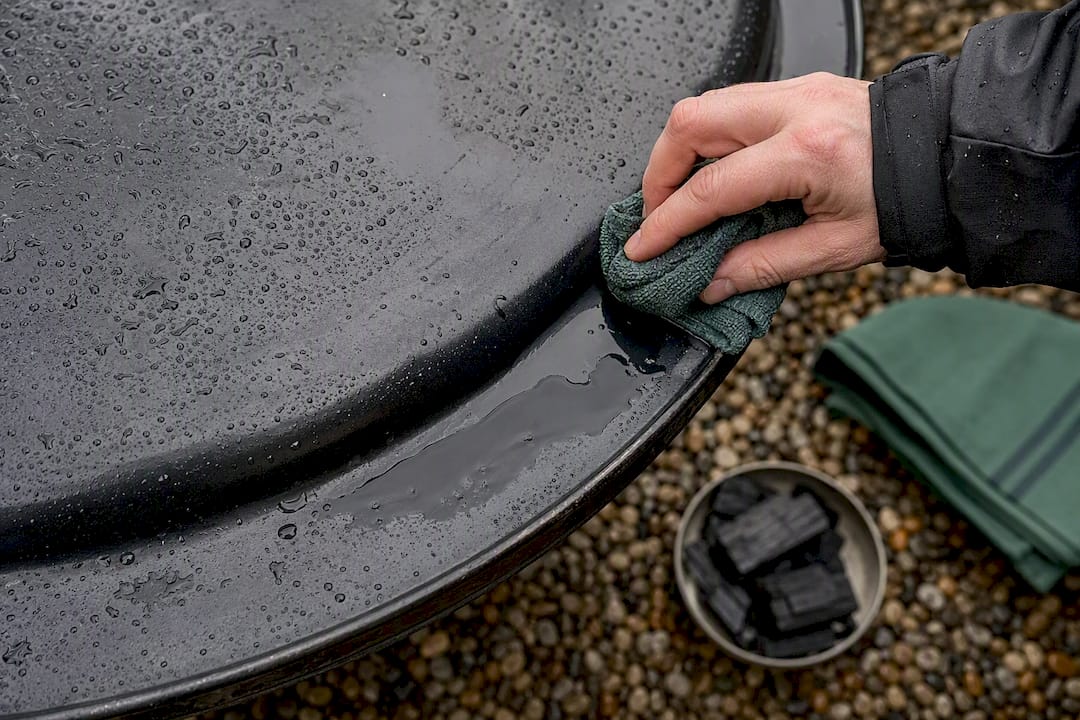
Pro Tip: Clear any standing water off the grill lid and hood before you light it. A pool of rainwater running down onto hot coals when you open the lid is both a scald risk and a fast way to lose your heat.
How does rain change your grilling time and temperature?
Rain and the humidity that comes with it pull heat away from your grill faster than dry conditions, so the fire has to work harder just to hold steady. Cooking with charcoal or wood in the rain means your fuel burns down quicker, and every lid opening costs you more heat than it would on a dry evening. Experienced pitmasters report losing a significant amount of internal heat each time the lid comes up, which in wet weather is a real setback rather than a minor annoyance.
The fix is straightforward once you know it’s coming. Preheat for longer than usual, add extra charcoal or increase your gas burn rate, and set your target temperature 10 to 15°C higher than you would on a clear day to offset the constant heat loss. The Telegraph’s guide to hosting a barbecue in the rain makes a strong case for switching your menu towards low-and-slow cooking in wet weather. Big joints, ribs, whole chickens, and root vegetables tolerate the temperature swings far better than delicate items like thin fish fillets or skewered prawns that need constant, precise attention.
That’s also where a wireless meat probe earns its keep. Instead of lifting the lid to check progress, and losing heat every time you do, you can watch internal temperature from under an awning or through the kitchen window. It’s arguably the single most useful piece of kit for anyone who insists on grilling regardless of the forecast.
A few more adjustments worth building into your routine:
- Use a chimney starter to get charcoal properly alight before it goes anywhere near a wet grill grate.
- Keep spare fuel sealed in a waterproof container rather than an open bag that soaks up moisture from the air.
- If you’re running a pellet grill, check the hopper stays completely dry; damp pellets jam the auger, and you’ll burn through more pellets than usual maintaining temperature in the wet.
- Store charcoal in a dry, sealed container even before rain is forecast, since damp briquettes struggle to hold a consistent heat.
Where should you put the shelter?
Getting the shelter right is mostly about ventilation, not just staying dry. A closed tent traps smoke and carbon monoxide; an open-sided one lets both escape while still keeping rain off the food and the cook.
- Choose an open-sided gazebo or canopy over anything with walls. Airflow matters more than full coverage, and a fully enclosed structure turns a barbecue into a carbon monoxide risk.
- Keep fabric well clear of the grill itself. Most canopy materials are treated to resist scorching, but heat rises and drifts, so leave generous vertical and horizontal clearance around any vents or flue.
- Position the grill upwind of your guests. Smoke and sparks travel with the wind, and nobody enjoys eating dinner through a haze.
- Build a solid, non-flammable windbreak if it’s gusty, rather than relying on the shelter fabric alone to block the wind.
- Resist the temptation to duck under the eaves or into an open garage doorway. It feels drier, but it puts you exactly in the path of the fumes a grill produces.
Umbrellas belong at the bottom of the list of solutions, not the top. If one is genuinely your only option, hold or prop it well away from the grill and never fix it directly to the appliance. A gust that tips a flaming grill and an umbrella together is a far worse outcome than getting a bit wet.
What kit makes a rainy cook actually manageable?
The right tools turn a stressful, soggy cook into a fairly ordinary one. A wireless probe thermometer sits at the top of the list, since it means fewer lid openings and less standing around in the rain checking progress by hand. Heatproof gloves and long-handled tongs keep your hands both dry and safe, and non-slip shoes matter more on wet paving than most people think until they’ve nearly gone over with a plate of ribs.
Fuel handling deserves its own attention. Keep briquettes in a waterproof container, carry spare fuel rather than assuming what’s in the grill will be enough, and use a chimney starter so you’re not fighting damp coals with lighter fluid. Foil trays for vegetables cut down on prep time under a dripping canopy, and a couple of battery lanterns beat trailing an extension cable through puddles.
| Category | Essential item | Why it matters in the rain |
|---|---|---|
| Temperature control | Wireless probe thermometer | Cuts down on lid-opening heat loss |
| Fuel | Waterproof storage, spare charcoal, chimney starter | Wet fuel won’t hold a steady heat |
| Personal safety | Heatproof gloves, non-slip shoes | Wet surfaces and hot metal don’t mix |
| Lighting | Battery lanterns | Keeps mains electrics away from the wet |
| Emergency | Fire extinguisher, sand or water bucket | Fast response if fuel or wind causes a flare-up |
Serving is worth planning too. Designate one person to carry food between grill and table, use covered trays for the short journey, and have a plan for drying and covering the grill the moment the cook is done.
Why rain shouldn’t be the reason you cancel
People treat rain as a hard stop for barbecuing far more often than the evidence supports. The real danger was never the water falling from the sky, it’s what a nervous cook does in response to it: dragging a lit grill under a car port, into a garage, or up against a wall to keep dry, all of which turn a manageable inconvenience into a genuine carbon monoxide risk.
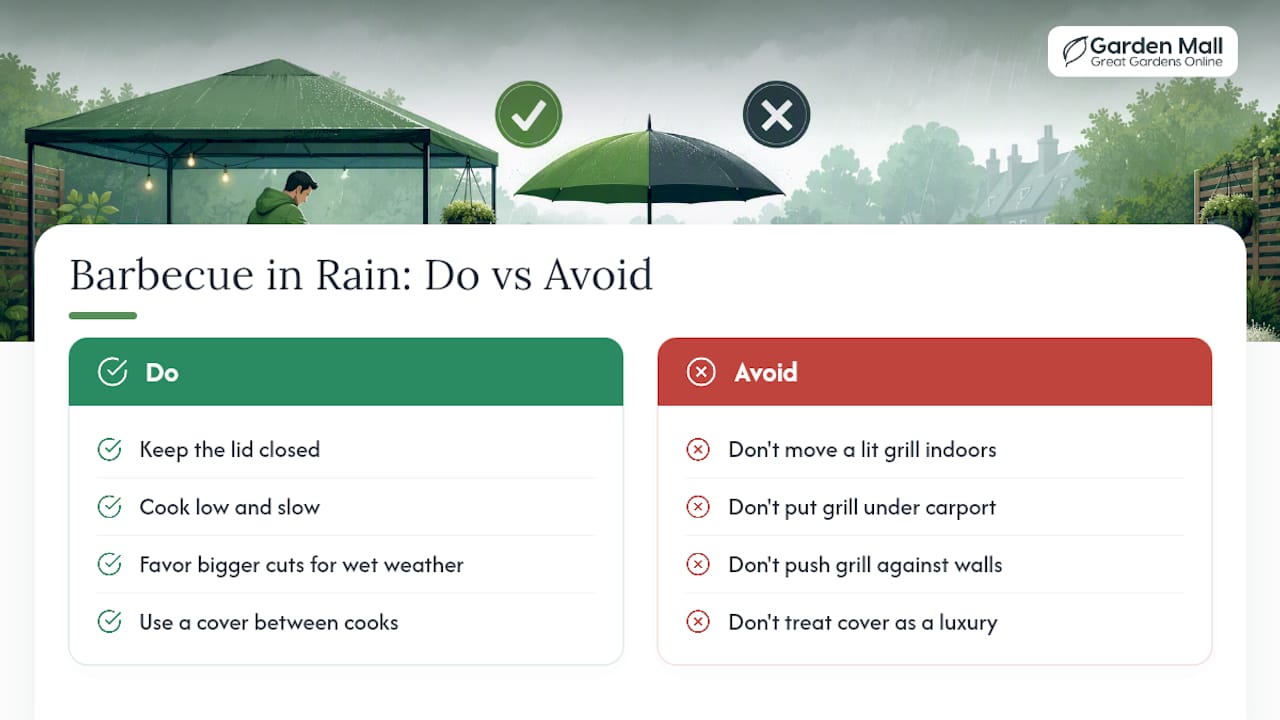
What tends to get underestimated is how much the food itself benefits from a wet-weather approach. Closing the lid more, running low and slow, and leaning on bigger cuts doesn’t just protect your heat, it also concentrates smoke and moisture in a way that can improve flavour on joints and vegetables that would otherwise dry out on a scorching, wind-whipped afternoon. The rain forces good habits that a lot of dry-weather cooks skip entirely.
If there’s a genuine mistake people make, it’s assuming a barbecue cover is a luxury rather than a basic tool. A cover that keeps a grill dry between cooks, and a shelter that keeps rain off the cook without sealing in fumes, solve almost every problem this article raises before they start.
— Peter
Where to find shelter, covers and grilling kit
If the forecast looks unreliable, sorting your shelter and cover before the weekend rather than mid-cook saves a lot of frustration. You can find barbecues, sheltering solutions, and protective covers built for this kind of British weather, so you’re not improvising with a bin bag and a hopeful attitude.
Delivery options and returns policies vary; check the retailer’s site for details if you need kit in a hurry rather than in a fortnight. Browse the outdoor shelters and barbecue accessories range to find a cover or canopy that suits your setup, and get it sorted before the next wet weekend catches you out.
Sources
- Derbyshire Fire & Rescue Service — safety video
- White Horse Energy — tips for barbecuing in the rain
- The Telegraph — how to host a barbecue in the rain
- BBQ Experience — smoking in the rain
FAQ
Is it safe to barbecue in the rain?
Yes, provided the grill stands on a stable, dry surface in a well ventilated outdoor space with no overhangs, and you never move it into an enclosed area like a garage.
What should you do if it starts raining during a barbecue?
Move to an open-sided, fireproof shelter positioned well clear of the flames, top up your fuel to compensate for the extra heat loss, and use a wireless probe to keep the lid shut as much as possible.
Is it okay for a barbecue to get wet?
A grill itself can get wet on the outside without much issue, but wet charcoal struggles to hold a consistent heat, and any mains-powered electrical parts must stay completely dry.
I forgot to cover my grill and it rained. Should I cover it now?
Yes. Dry off any standing water, then fit a cover as soon as possible to stop rust setting into the grates and body, and check the fuel compartment for damp charcoal before your next cook.
Can you use a gazebo over a barbecue in the rain?
Yes, as long as it’s open-sided rather than fully enclosed, with the fabric kept well clear of the flames and vents so smoke and heat can escape properly.
